
- UK

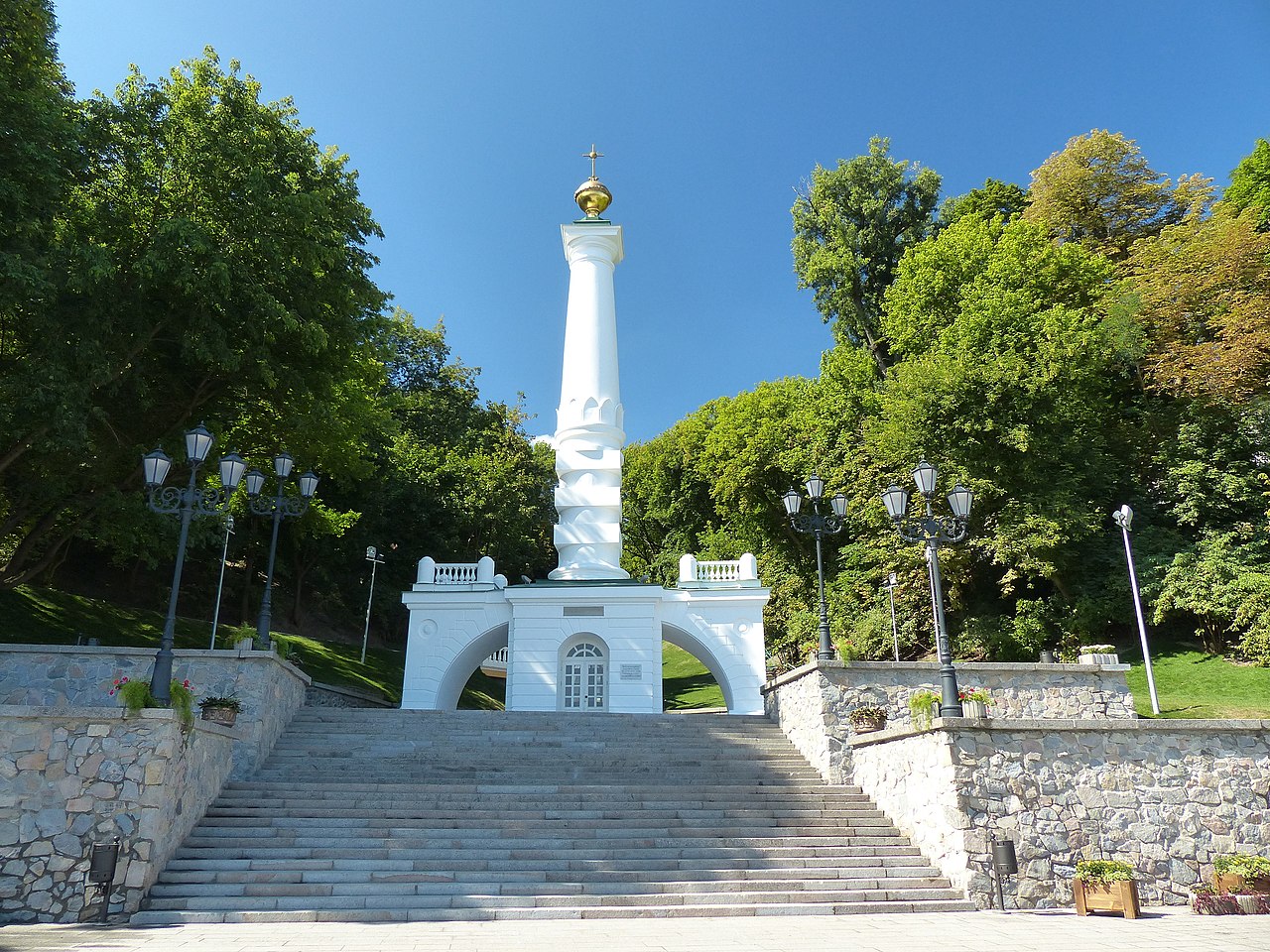
Amid the sweeping Kyiv hills, along Naberezhne Highway, rises one of the city’s oldest architectural landmarks - the Monument to Magdeburg Rights. Over time it has been known by different names: the “Lower Monument to Prince Volodymyr,” or even the “Monument to the Baptism of Rus.” The latter title emerged in the 19th century, linked to the legend that it was here that Prince Volodymyr baptized his children.
The true history of the monument, however, runs deeper. Its very name recalls the era when Kyiv enjoyed a unique system of self-governance. In 1494, Grand Duke Alexander of Lithuania granted the city Magdeburg Rights - a special privilege that allowed Kyivans to rule themselves, elect a magistrate, and resolve economic and judicial matters without outside interference. These rights were reaffirmed multiple times between 1514 and 1516. Yet in 1764, a decree abolished them, subordinating Kyiv’s magistrate to the authority of the governor-general.
More than thirty years later, in 1802, Emperor Alexander I restored the city’s rights and freedoms. Kyiv erupted in celebration: for three days the people held grand balls, lit festive illuminations, and danced in the squares. To commemorate this joyous occasion, the citizens resolved to build a monument, and swiftly raised ten thousand rubles for its construction. The project is widely believed to have been designed by the distinguished Kyiv architect Andriy Melenskyi. Though no direct documents confirm this, researchers have uncovered a drawing bearing his signature - an indirect yet persuasive proof of authorship.
The monument, rising 18 meters high, impresses with its restrained classical beauty. It is a Tuscan-order column set on a pedestal composed of two volumes: a large arch with a square block inside, adorned with a semicircular window. Atop the column rests a gilded orb crowned with a cross. In monarchical symbolism, the orb signifies power; in Christian tradition, it represents the Kingdom of Heaven. During Soviet times, the cross was removed and was only restored after Ukraine regained its independence.
Inside the pedestal once stood a small chapel. At its center was an octagonal basin with a fountain, supplied with spring water through wooden pipes leading from a reservoir higher up the slope. For its time, this hydrotechnical system was highly advanced, serving not only a decorative function but also drainage. Its remains were uncovered in 1940 during soil drilling.
By 1843, the monument required major repairs, which were completed in 1867. In 1912, an official inspection declared it unsafe, yet it remained a cherished pilgrimage site. In 1913, under architect Bobrusov, large-scale restoration began. Between 1914 and 1915, stone stairs were added, connecting Oleksandrivskyi Descent (today Volodymyrskyi Descent) with the monument.
In 1985, restorer Iryna Malakova conducted meticulous measurements of the stairs and drafted a reconstruction project. It envisioned paving the landings with granite, replacing damaged balusters and railings, and restoring the arcade’s decor and lighting. Unfortunately, many of these plans were never carried out.
On the eve of the millennium of the Baptism of Rus, in 1988, the monument and its surroundings were restored, the stairs repaired, and an underpass built beneath Naberezhne Highway to connect the site with the Dnipro embankment.
The most recent major restoration took place in 2013. The column was refurbished, the chapel inside the central arch renewed, and a pleasant pedestrian zone with benches created. The underpass near the monument was decorated with metal panels dedicated to the Baptism of Kyiv.
Today, this monument is more than just an architectural landmark. It embodies the free spirit of Kyiv, its European traditions of self-governance, and its profound spiritual roots - reminding all who pass by that the history of freedom is inseparable from the history of this city.