
- UK

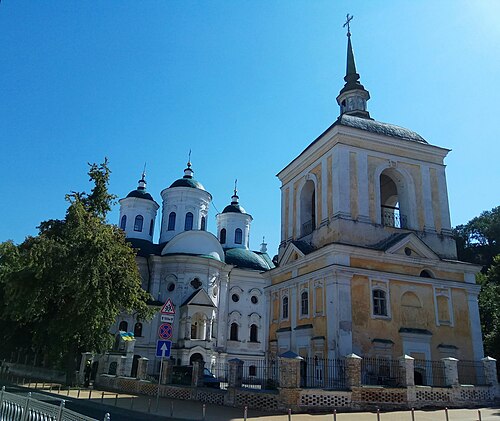
Amid the old streets of Podil, at the intersection of Pokrovska Street, Pokrovskiy Lane, and Borychiv Tik, stands Pokrovska Church - a true masterpiece of Kyiv Baroque. The complex consists of the main 18th-century church, a two-story 19th-century annex that served as a “warm” church, and a separate bell tower erected somewhat later.
The site’s history reaches back centuries. In 1685, a wooden church funded by the Greek merchant Mykola Ternaviot stood here, replacing - depending on the version -either a burned Armenian church or a Bernardine monastery. Since the 14th century, Podil had been home to a wooden Church of the Nativity, which served its Armenian trading community.
Between 1766 and 1772, architect Ivan Hryhorovych-Barskyi, then Kyiv’s chief magistrate architect, designed a new stone church in the Ukrainian Baroque style. Its plan echoed the tradition of wooden three-part churches: a cruciform layout, a semicircular apse, and three domes. The facades were adorned with graceful windows framed in rich ornament.
The great fire of 1811 nearly destroyed it, devouring the roof, windows, and much of the interior. Restoration, completed in 1817, added a new “warm” church in the Empire style. In 1861, a new iconostasis was installed, though it was later dismantled during the Soviet period.
In the 1920s, the church passed between various Orthodox jurisdictions until it was closed by the Soviet authorities in 1929. During World War II, services were resumed, and Father Oleksii Hlaholiev courageously sheltered Jewish families within its walls, even refusing to honor Hitler - a stand that brought persecution.
After the war, repairs were carried out, but in 1960 the church was closed once again and given over to secular use. Only in 1991 was it finally returned to the faithful. For many years it served as the cathedral of the Ukrainian Autocephalous Orthodox Church, and since 2019 it belongs to the Orthodox Church of Ukraine.
The bell tower, originally designed by Hryhorovych-Barskyi, was rebuilt after the fire in 1831, this time in the classical style. In later years, it housed cultural organizations. Today, Pokrovska Church stands as a national monument - a vivid symbol of Podil’s enduring faith and history.