
- UK

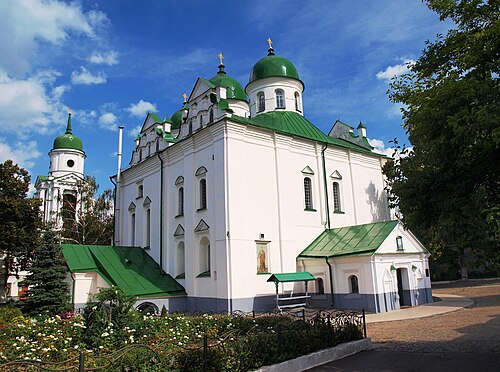
In the heart of bustling Podil, amid its narrow winding streets, lies Kyiv’s oldest convent- the St. Ascension Florivsky Convent. Its name honors the martyrs Florus and Laurus, revered as protectors of horses and cattle. Icons traditionally depict them with horses, for it was the Archangel Michael who, according to legend, taught them the art of horsemanship.
Why, then, do some call it Frolivsky? In the 1920s, Soviet authorities renamed Florivska Street, erasing its religious meaning by altering a single letter. Yet historians note that the popular form “Frol” had circulated even earlier.
Unlike most convents, usually built beyond city walls, this one rose in the very heart of lively Podil. First mentioned in 1566, it likely dates back to 1541–1560. Its monastic rules were so strict they rivaled those of the Kyiv Pechersk Lavra. The nuns lived humbly in modest wooden cells.
The convent’s first stone building was the refectory church, constructed in 1698–1699, though it often suffered from fires. After the devastating fire of 1811, architect Andriy Melenskyi restored it in Baroque style.
In 1711, when Peter I closed the Ascension Convent once led by the mother of Hetman Ivan Mazepa, its nuns and property were transferred here - a turning point that spurred Florivsky’s growth.
The main Ascension Cathedral, built in 1732 in Ukrainian Baroque style, may have been designed by Ivan Hryhorovych-Barskyi. It underwent several reconstructions and was later altered by Soviet restorers. Other notable structures include the abbess’s house (1816–1821, by Melenskyi) and the bell tower, later crowned with an Empire-style spire. In the 19th century, a church dedicated to the Kazan Icon of the Mother of God was added to the complex.
Closed in the 1920s, the convent was repurposed for housing and workshops. During World War II it suffered damage, but under the German occupation religious life briefly returned. In the late 1940s and 1950s, repairs were carried out, though in simplified forms that stripped the buildings of much of their original detail.
Revived in 1991, the convent today belongs to the Ukrainian Orthodox Church (Moscow Patriarchate). Its walls still bear witness to centuries of trials, endurance, and faith, standing as a symbol of spiritual resilience in the historic district of Podil.